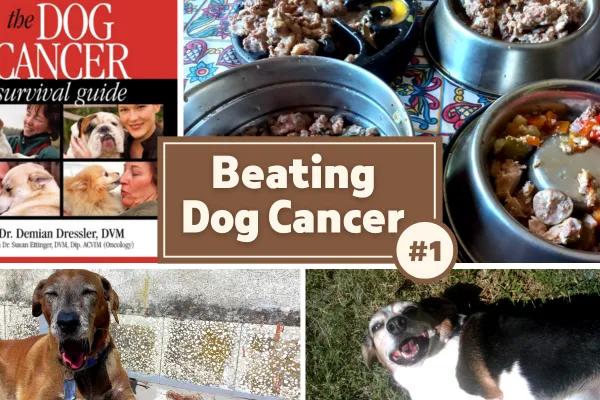
🐾 Book Review: The Dog Cancer Survival Guide by Dr. Demian Dressler & Dr. Sue Ettinger
Does Your Dog Have Cancer?
The Dog Cancer Survival Guide should be on your bookshelf. Written by Dr. Demian Dressler (“The Dog Cancer Vet”) and Dr. Sue Ettinger, a board-certified oncologist, this book has changed the lives of countless dogs and their guardians.
It has been absolutely essential in my home, and with my dogs, as well.
Frankly, I wish I had access to this info two decades ago... it would have really helped not only with the treatment of some of my old dogs, but with my own mental and physical health while helping them battle cancer.
It’s not just a guide. It’s a battle plan — filled with science-backed strategies, emotional support, and nutritional insights that empower you to become your dog’s best advocate.
🐾 Book Review: The Dog Cancer Survival Guide by Dr. Demian Dressler & Dr. Sue Ettinger (Table of Contents)
❤️ Why This Book Matters for Dogs with Cancer and Their Parents
💪 1. Developing the Warrior Dog Guardian Mindset
Sometimes, the cancer itself isn't the worst part of your dog having cancer...
Why would you need to be a fierce advocate?
😞 You're Terrified? Great, Meet Your Uncaring Oncologist
🐕 Master Your Emotions, Help Your Dog Live Longer
🍖 3. Fantastic Nutritional Advice
🌿 4. A Full-Spectrum Approach: Traditional + Holistic
😱 A Guy on a Bike Fell - Send the Whole Hospital!
❤️ Why This Book Matters for Dogs with Cancer and Their Parents
This isn’t a “feel good” book that offers empty hope.
It offers real, actionable steps — explaining why certain treatments and strategies work, why others don’t, and how to create a full-spectrum plan to help your dog live as long and as well as possible.
The concept of a full-spectrum plan, we'll explain more later in the article, but it is a concept so simple that it is often overlooked. It is also incredibly effective not only in helping dogs with cancer, but helping dogs liver better, and longer, in general.
Whether your dog is fighting cancer, recovering from it, or you simply want to prevent disease, this book gives you the mindset and tools to help them thrive.
💪 1. Developing the Warrior Dog Guardian Mindset
Sometimes, the cancer itself isn't the worst part of your dog having cancer...
Getting a cancer diagnosis for your dog is one of the hardest moments you’ll ever face. Dr. Dressler guides you through the emotional side of it — how to release fear and grief, how to stay grounded, and how to be strong for your dog.
Dogs can sense our emotions. When we’re anxious, stressed, or heartbroken, they feel it — and that stress fuels inflammation, which can worsen cancer.
So this “guardian mindset” is about:
🐾 Being emotionally strong — not hiding feelings, but processing them in healthy ways.
🐾 Staying calm and confident around your dog to help them feel secure.
🐾 Becoming a fierce advocate — standing up for your dog, asking questions, and never settling for “there’s nothing more we can do.”
Why would you need to be a fierce advocate?
Because, again, sometimes the cancer isn't the worst part...
It is how you and your dog can be treated.
I'm going to share some personal examples here, and I'll preference them by saying we love veterinarian. We have been fortunate to be under the care of some of the best in the world.
However, especially when cancer is involved and your dog is older, you are going to find the darkside of the for-profit vet clinics smacking you in the face.
Meet Lucia and Ghangis

They are a prime example of why you need to be mentally prepared to:
Question a diagnosis
Get a second opinion
Advocate for your dog as if their life depends on it... because it does
When Ghangis was around 14, she started to drink a lot of water. She got blood tests. Clean.
In fact, the vet said she has the results of a 3-year old dog.
A month later, a tumour started to grow on on the side of her tail...
Our vet suggested going into the big clinic for more advanced tests.
Two days before her appointment, 1-year old Lucia collapsed while playing. She was rigid, breathing heavily, and only semi-conscious.
I rushed her to the emergency vet, the same clinic where Ghangis would have her appointment.
After several MRIs, tests, blood withdraws from her jugular vein, and a few weeks of absolute around the clock care, she was diagnosed with a rare autoimmune disorder which would require chemotherapy to treat.
Ghangis, in the meantime, was diagnosed with cancer.
This is where the ugly side of for-profits shows it's putrid face.
😞 You're Terrified? Great, Meet Your Uncaring Oncologist
Ghangis went first. We waited in line for several hours in searing Sicilian summer heat. Luckily, she was strong, and didn't mind the wait. There were at least a dozen dogs, all waiting to see the oncologist, who weren't so lucky.
They waited and waited, sick and sad and simmering. Their parents couldn't help them.
This was a cattle call... specialists who go from clinic to clinic, stacking appointments back to back, to make a ton of money in one day.
This doesn't give you much time with the ONLY person who can help your dog live.
When we finally got in, we got a cold, unfeeling diagnosis:
"She's old, she has cancer. Not much we can do. Try this (basic, catch-all) chemo. Maybe... maybe, she'll have a few more weeks. NEXT!"
A few day later, she was had a second appointment to pick up the chemo pills, but this time with Lucia who needed to get her prescription, too.
This is where I had to keep myself from physical violence.
This smug oncologist, who was completely dismissive of 14-year old Ghangis, was ENTHRALLED with Lucia.
💰 A 1-year old dog who would need to be on chemo forever?
💰 A lifetime of follow up appointments?
💰 Possible future MRIs?
💰 7 - 12 more years of treatment?
Jackpot.
To be clear:
The old dog? Who cares. Take these and hope for the best, but she's a lost cause.
The young dog? Let's do EVERYTHING possible for her.
Queen Ghangis, waiting for her homemade dog food breakfast to be brought to her while she sunbathes on the roof
Luckily, our primary care vet had a friend, an oncologist, on the other side of the country. Ghangis and I piled in the car, and off we went in a heat that could melt steel.
She was happy to have endless hours with me. I was trying not to stay calm, drive, and not burst into flames.
The treatment was a completely different world.
The new oncologist?
Performed endless tests.
She was caring.
She sat and discussed a myriad of treatment options.
She also, respectfully, told me that her fellow oncologist had misdiagnosed Ghangis.
Yes, she had cancer, but it was a completely different type, requiring different treatment, and with a different prognosis.
So what happened?
Ghangis thrived... she didn't just live... but she THRIVED for 19-months.
Lucia, now 5, is still thriving, too, crazy as ever. We take special care to make sure her kidneys and liver stay healthy while on long term chemo.
This is why asking for second opinions is vital. This isn't the first time we dealt with an oncologist blowing off a dog because they were a senior.
🐕 Master Your Emotions, Help Your Dog Live Longer
The Dog Cancer Survival Guide really excels in teaching dog parents how to do what might be the most difficult thing when helping their dogs fight cancer: master their negative emotions.
🤬 You may want to cry. Or scream. Or break things. Or fall into a depression.
Great. Do what you need... but do it far from your dog.
Dogs are so attuned to our emotions that, at times, it can be eerie.
They know when you're sad, or happy, or angry.
📚 The book goes into detail on how to channel those emotions, process them, and experience them, away from your dog, so that when you're with them, you can be positive, happy, and fill them with positivity.
Their immune system, I believe fully, is effected by their emotions. Their body is at war with itself. It has to fight off one of nature's all-time great killers.
Their system needs ALL the help it can get, and we need to make sure that they don't experience any new stress.
🦠 Stress is part of the inflammatory cycle. It is degenerative.
They may be dealing with bad tasting meds and trips to the vet. Let's not pile more stress on them.
Instead, follow the book's advice on how to relieve your rage, sadness, depression, etc.
This way all your time with your dog can be spent smiling, walking, eating, playing, and having fun. It may not only improve their life, but help them live longer.
🏥 2. The Power of Advocacy
Not every oncologist is bad, clearly. The second doctor was amazing.
However, not every veterinarian or oncologist takes the same approach. While many are compassionate and knowledgeable, others may take a “palliative only” stance with older dogs.
Also, even in the best cases, two doctors may take a completely different path to treating the problem. This is natural, as there isn't always ONE best way to deal with something as complex as cancer.
Dr. Dressler teaches you how to advocate for your dog’s life — even if that means finding a new vet, traveling for better care, or requesting a more personalised treatment plan.
🐾 Real-life stories throughout the book show how persistence and informed decisions can turn hopeless cases into success stories.
🐾 You’ll learn how to partner with your vet rather than just follow orders.
🍖 3. Fantastic Nutritional Advice
Here’s where the book truly shines. Unlike many conventional vet guides, Dr. Dressler emphasizes the critical role of nutrition in both cancer prevention and treatment.
He dives deep into:
🐾 Natural, home-cooked diets
🐾 Low-carb, anti-inflammatory feeding strategies
🐾 The ketogenic approach for dogs with cancer
🐾 The best supplements to help treat doggy cancer and to support your dog's system during chemo or other treatments like radiation, oxygen therapy, etc.
These dietary principles align closely with what’s being used successfully at research institutions and in real-world clinical settings. Nutrition alone can’t cure cancer, but it can profoundly support your dog’s immune system and energy — and sometimes, it can turn the tide.
While Dr. Dressler opts for a low-carb approach, we favour a ketogenic diet for dogs with cancer (and many seniors) - Click here to see how to set it up for your pup

🌿 4. A Full-Spectrum Approach: Traditional + Holistic
One of the book’s most powerful messages is that you don’t have to choose between traditional and holistic medicine.
Dr. Dressler and Dr. Ettinger often present different viewpoints — sometimes even opposite ones — to help readers see all sides of treatment options.
🐾 Traditional care: Surgery, chemotherapy, radiation
🐾 Holistic tools: Supplements, nutritional therapy, oxygen therapy, emotional care
This dual perspective helps you and your vet craft a custom plan that fits your dog’s needs, your budget, and your philosophy.
It’s not about being “anti-vet” or “anti-natural.” It’s about being pro-dog — and using everything that works.
Please don't confuse holistic with homeopathic.
Holistic simply means using a wide variety of tools, even the non-traditional, to solve the problem. Traditional therapies like chemotherapy are 100% a part of a holistic approach (should you choose to use them, if they're the right choice for your dog, etc.)
😱 A Guy on a Bike Fell - Send the Whole Hospital!
Dr. Walter Longo, an Italian researcher in cancer, and longevity, and who is a pioneer in using fasting as part of cancer treatment, talked about a strange experience he had while interning in a hospital in California, USA.
While studying, he heard a cacophony of sirens. He went out side to see what happened, and saw that a man on a bicycle had been in an accident.
The police, the firemen, and paramedics all arrived on scene. He was taken to the hospital where surgeons would look at his injuries, nurses would care for him, and if he needed surgery, others specialists would be involved in his care.
Later that day, he was doing his rounds and found a woman in the halls, confused and crying.
She had been given a cancer diagnosis, then sent on her merry way.
It struck Dr. Longo that, the person who is sent to an oncologist, deals only with the oncologist, gets horrific news, and then is given no more support other than a follow up appointment while a guy in a bike accident has the support for a crew of medical and emergency professionals.
His theory is that cancer treatment should be this way: a team (holistic) effort that included:
Primary doctor
Oncologist
Nutritionist/someone who can help with diet for those with cancer
Trainer and/or exercise support, again with a speciality in people facing cancer
Emotional support from a therapist
He's right, and the same goes for your dog. Dr. Dressler's holistic approach is what we need.
Nutrition
Medical
Pharmaceutical
Supplemental
Physical
Emotional - for you and your dog
💊 5. Supplementation: The Hidden Superpower
The supplement section alone is worth the book’s price a hundred times over.
Dr. Dressler explores how certain nutrients and compounds can:
🐾 Support your dog's immune system
🐾 Reduce inflammation
🐾 Slow or even destroy cancer cell growth
🐾 Boost energy and recovery during chemo or radiation
Some highlights include:
🌿 Medicinal mushrooms — like Turkey Tail and Cordyceps, shown in studies to modulate immune activity and increase survival time.
🌿 DIY supplement strategies — many are simple and affordable to make at home. We also support this food-supplements approach mixed with traditional supplementation
🌿 APO-Caps — a supplement developed by Dr. Dressler himself, designed to help trigger cancer cell apoptosis (self-destruction) and improve overall vitality.
👉 These supplements aren’t meant to replace medical treatment — but they can work alongside it to dramatically enhance results.
🧠 Final Thoughts: Why Every Dog Owner Should Read This Book
Whether your dog is healthy or already fighting cancer, The Dog Cancer Survival Guide gives you:
✅ A roadmap of what to do next
✅ The confidence to ask better questions
✅ The emotional tools to stay strong
✅ The nutritional foundation to help your dog thrive
This isn’t just a “book about cancer.” It’s a book about love, science, and hope — for every dog parent who refuses to give up.
📚 Next Steps
🐾 Buy the book – It’s a resource you’ll refer to again and again. We do NOT make ANY money from the sale of this book. We recommend it because it will help your dog.
🐾 Watch our review of APO-Caps – Learn how this supplement works and how it can help your dog.
🐾 Stay informed – Follow evidence-based nutrition, stress management, and supplement strategies for senior dogs: download your FREE supplements for dogs guide below...


