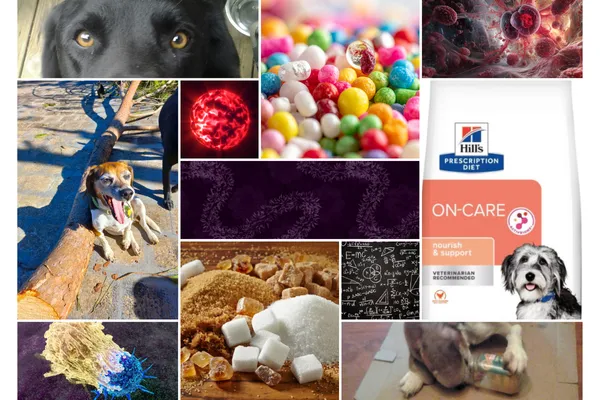
Hill’s ONC Dog Food Review
Why This “Cancer Diet” Dog Food May Be Doing the Exact Opposite of What Your Dog Needs
If your dog has cancer, would you intentionally feed a diet that’s 34–40% sugar, built on heavily processed grains, low-value plant proteins, and inflammatory ingredients?
Because that’s exactly what happens when people feed Hill’s Prescription Diet ONC — a food marketed as oncology-supportive, but formulated in a way that raises serious metabolic and biological concerns for dogs with cancer.
This article is not about taste tests.
It’s not about branding.
And it’s definitely not about “vet-approved” labels.
It’s about ingredients, metabolism, inflammation, and biological reality.
Note: We are NEVER paid for dog food reviews.
Hill’s ONC Dog Food Review (table of contents)
Why This “Cancer Diet” Dog Food May Be Doing the Exact Opposite of What Your Dog Needs
Hill’s ONC Ingredients: The Real Story
🍬 The Biggest Problem: Sugar (a LOT of It) 🍬
Why This Matters — Especially for Cancer Dogs
🧬 Nerd Alert: The Warburg Effect (Simplified)
Ultra-Processing Makes It Worse
Why Corn, Wheat, Soy & Rice Are Especially Problematic
🧪 Nerd Alert: Inflammation, Insulin & Cancer Environment
The Cost Problem (Yes, It’s Expensive)
What Should a Cancer-Supportive Diet Look Like?
✅ Option 1: Homemade (Preferred)
⚠️ Option 2: Commercial Food (If You Must)
❓ Is Hill’s ONC actually good for dogs with cancer?
What Hill’s ONC Claims to Be
Hill’s ONC is positioned as:
🏥 A "vet approved" prescription oncology diet
🧬 “Scientifically formulated” for dogs with cancer
💰 A premium food, priced accordingly
🩺 Often recommended during chemotherapy or cancer treatment
On paper, that sounds reassuring.
But, commercial dog food isn’t medicine.
It’s ingredients + processing + metabolic impact.
So let’s look at what’s actually in the bag, and how it stands up to real food for dogs with cancer.
🦠Hill’s ONC Ingredients: The Real Story
Primary ingredients include:
Chicken
Whole grain wheat
Corn gluten meal
Chicken fat
Hydrolysed chicken liver
Soybean meal
Brown rice
Cracked pearl barley
Egg product
“Chicken liver flavour”
🚩 Immediate Red Flags
🌾 Four separate grains (wheat, corn, rice, barley)
🌱 Soybean meal (estrogenic, inflammatory, highly processed)
🧪 Flavour additives instead of real organ meat
📦 Heavy reliance on cheap plant protein boosters
This isn’t “oncology nutrition.”
This is cost-optimized dry dog food formulation with a medical label slapped on it.
🍬 The Biggest Problem: Sugar (a LOT of It) 🍬
Hill’s ONC derives 34–40% of its calories from carbohydrates.
Let’s call that what it is:
🍬 Sugar
Why This Matters — Especially for Cancer Dogs
Dogs have no biological requirement for carbohydrates
Cancer cells preferentially rely on glucose for energy
High-carb diets elevate:
📈 Blood glucose
📈 Insulin
📈 IGF-1 signaling
All of which are growth-supportive signals at the cellular level.
🧬 Nerd Alert: The Warburg Effect (Simplified)
Cancer cells behave differently than healthy cells.
Healthy cells:
Efficiently use fat and ketones
Generate energy via oxidative metabolism
Many cancer cells:
Prefer glucose fermentation
Continue using glucose even when oxygen is present
This phenomenon is known as the Warburg Effect.
👉 Feeding a high-carbohydrate diet may support the very metabolic pathway cancer cells prefer, rather than stressing it.
This isn’t a fringe idea — it’s foundational cancer metabolism science.
Ultra-Processing Makes It Worse
Hill’s ONC is:
🔥 Cooked multiple times
🔁 Subjected to extreme heat
🧬 Chemically altered far beyond “food”
By the time this kibble reaches your dog’s bowl:
Proteins are denatured
Fats are oxidised
Grains are no longer nutritionally intact
Advanced glycation end products (AGEs) increase
Even if grains were neutral (they aren’t), this level of processing removes any remaining benefit.
Why Corn, Wheat, Soy & Rice Are Especially Problematic
🌽 Corn
Cheap plant protein booster
Low biological value (~64)
Incomplete amino acid profile
🚮 Produces high nitrogen waste
💥 More stress on kidneys & liver
Compare that to:
🥚 Eggs
Biological value: 100
Perfect amino acid profile
High leucine → muscle preservation
Minimal metabolic waste
Corn exists to inflate protein numbers on the label, not nourish sick dogs.
🌾 Wheat & Barley
Highly inflammatory
Poor digestibility
Low amino acid usability
Strong gut irritants in compromised dogs
🌱 Soybean Meal
Yes, soy’s biological value is higher than corn — but that’s not the whole story.
Soy contains:
⚠️ Phytoestrogens (hormone-active compounds)
⚠️ Anti-nutrients that block mineral absorption
⚠️ Highly processed proteins
⚠️ Increased inflammatory signaling in susceptible animals
Cancer dogs are already:
Older (usually)
Immunocompromised
Gut-fragile
Under metabolic stress
Soy adds another layer of biological noise their system does not need.
🧪 Nerd Alert: Inflammation, Insulin & Cancer Environment
Cancer doesn’t grow in isolation.
It responds to its environment.
High-carb, grain-heavy diets are associated with:
🔥 Increased inflammatory cytokines
📈 Insulin & IGF-1 signaling
🧫 Pro-growth cellular conditions
🦠 Worsened gut permeability (especially during chemo)
Cancer dogs don’t need their bodies working overtime just to digest food.
They need metabolic calm, nutrient density, and usable energy.
The Cost Problem (Yes, It’s Expensive)
Average pricing:
💰 ~€60 for a 4 kg bag
💸 ≈ €15 per kilo
Compare That to Homemade
Our real-world homemade diet averages:
🥩 €6.45–€6.50 per kilo
Using real meat, eggs, broth, veg, and supplements
👉 Hill’s ONC is ~2.5× more expensive
👉 And delivers lower biological value

That extra money could be used for:
🧂 Better vitamin & mineral support
🦴 Bone broth for collagen
🥩 Real protein toppers
What Should a Cancer-Supportive Diet Look Like?
Not this.
A more biologically appropriate approach emphasises:
🥩 Highly bioavailable protein
🧈 Healthy fats as the primary energy source
🐟 High EPA & DHA
🥦 Low-glycemic fibrous vegetables
🦠 Probiotic & gut-supportive foods
🍬 Minimal to near-zero carbohydrates
Helpful Additions
🦴 Collagen & bone broth (scaffolding support)
🧠 Omega-3s (EPA/DHA)
🧬 Glucosamine & MSM
🦠 Fermented foods (when tolerated)
Your Two Realistic Options
✅ Option 1: Homemade (Preferred)
A properly formulated low-carb / ketogenic-leaning homemade diet allows you to:
Control ingredients
Reduce glucose availability
Increase usable protein & fat
Support gut and immune health
⚠️ Option 2: Commercial Food (If You Must)
If commercial food is unavoidable:
❌ Avoid grain-heavy “prescription” diets
❌ Ignore oncology branding
✅ Choose foods with:
Low carbohydrate load
Named animal proteins
Minimal processing
We break these down in our commercial dog food review playlist.
FAQ: Hill’s ONC Dog Food
❓ Is Hill’s ONC actually good for dogs with cancer?
Based on ingredient composition and metabolic impact, it raises serious concerns, particularly due to its high carbohydrate content and inflammatory ingredients.
❓ Why do vets recommend it?
Veterinary nutrition education is often brand-sponsored, and many vets are trained to trust prescription labeling rather than metabolic context.
❓ Can dogs digest grains?
Dogs can digest some grains — but that doesn’t mean they should, especially during cancer, when inflammation and insulin signaling matter.
❓ Is a ketogenic diet safe for dogs with cancer?
When properly formulated and monitored, fat-based, low-carb diets align well with canine metabolism and reduce reliance on glucose.
❓ Is homemade food expensive?
In practice, no — it’s often cheaper than prescription oncology kibble, with vastly better ingredient quality.
Final Verdict
Hill’s ONC isn’t oncology nutrition.
It’s:
A high-carbohydrate kibble
Built on cheap grains and plant proteins
Ultra-processed
Expensive
And metabolically misaligned with what dogs — especially dogs with cancer — actually need
If a food feeds the cancer metabolic cycle instead of stressing it, no label, recommendation, or marketing claim can fix that.
Your dog deserves better.

