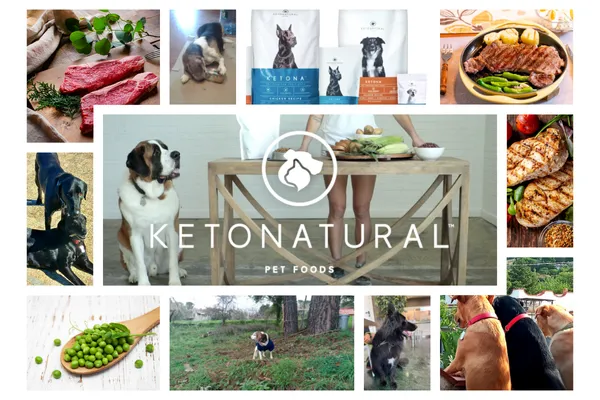
Ketona Dog Food Review
Is Ketona Dog Food Really “Keto”? An Honest Look at the Pros, Cons, and Hidden Problems
If you’ve been researching low-carb or ketogenic dog foods, you’ve probably seen Ketona (KetoNatural Pet Foods) appear again and again. It’s marketed as a science-backed, low-carb formula inspired by the ancestral diets of dogs. And, because obesity is an epidemic in modern pets, a food that promises low carbohydrates sounds like a step in the right direction.
Not to mention that carbs in dog food can lead to chronic, low-grade inflammation that can hurt your dogs's joints, and shorten their life.
But does Ketona actually live up to its name?
In today’s deep-dive review, we break down what Ketona does right, what it gets very wrong, and why so many dog parents feel misled by the branding. As always, we start with the negatives—because when it comes to dog food, honesty protects your dog’s health more than any marketing claim ever will.
The Origin Story: A Promising Beginning…
Before we get into the issues, it’s worth acknowledging something important:
The founder of KetoNatural created the company after watching his own family dogs struggle with serious obesity, a condition that now affects over 50% of dogs in North America, the UK, and in many places here in Europe. His mission, on paper, was admirable:
🌽 Reduce unnecessary carbs in dog food
🥩 Move toward biologically appropriate feeding
🐠 Provide a healthier option based in science and real-world outcomes
He even wrote a book addressing the “carb problem” in modern dog diets, highlighting how high-starch kibble contributes to weight gain, inflammation, and metabolic disease.
So the mission is solid.
The execution, however… is where things begin to fall apart.
❌ NEGATIVE #1: Ketona Is Not Keto... And the Branding Is Misleading
Let’s be absolutely clear:
Ketona is not a ketogenic dog food. Not even close.
A true ketogenic diet for dogs follows a (at least) 70% fat / 30% protein ratio, with near-zero carbohydrates. Some therapeutic protocols even use an 80/20 fat-to-protein structure.
This is critical for:
Dogs with autoimmune conditions
Dogs with neurological issues
Anyone intentionally using nutritional ketosis as a therapeutic tool
But Ketona?
It delivers high protein, moderate fat, and reduced carbs, but nowhere near the nutritional profile required to induce ketosis.
Why This Is a Serious Issue
The company is named KetoNatural.
The food is called Ketona.
The website strongly implies “keto dog food.”
But the macros simply do not reflect a ketogenic formula. And most pet parents:
Don’t have time to analyse ingredient ratios
Don’t know how to calculate carb percentage from guaranteed analysis
Trust the branding at face value
🐶 If you want to learn how to calculate the carbs in dog food, watch this:
And that’s the problem.
❗ This isn’t just misleading—it can completely derail a dog’s therapeutic diet.
If a dog truly needs ketosis (for cancer management, seizures, autoimmune conditions), feeding a food that only sounds keto but isn’t can genuinely harm progress.
Verdict:
👉 Extremely misleading branding. A major integrity issue.
Note: Ketona isn't a bad food overall, it simply isn't keto.
❌ NEGATIVE #2: Heavy Use of Pea Protein & Ground Peas
Once we get past the misleading “keto” label, things unfortunately do not improve when we look at the ingredient list.
Ketona dog food contains a LOT of peas and pea protein, and that raises several concerns.
🔬 1. Peas Have Been Linked to DCM
While the FDA has not proven causation, multiple investigations and veterinary cardiologists have reported a pattern:
Diets high in peas, lentils, legumes appear in dogs diagnosed with Dilated Cardiomyopathy (DCM).
Again—not proven. But with heart health, the rule of thumb is simple:
👉 Why take unnecessary risks?
Especially when other protein sources exist that pose no potential cardiac concern. The reality is that pea protein probably doesn't increase the risk, but why take any risk at all?
🔬 2. Pea Protein is a Cheap Filler
Why do companies use pea protein?
It’s cheap
It boosts “protein percentage” on the label
It saves money compared to real meat proteins
When a bag of dog food costs $125 for 12kg (≈25 lbs), pea protein should never be the first or second prominent ingredient.
And yet, in Ketona:
Chicken or beef appears first (good!)
Immediately followed by ground peas and pea protein (bad!)
That means a bulk of your dog’s “protein” is coming from a plant that dogs can’t efficiently digest.
🌱 3. Poor Bioavailability
Dog digestive systems are designed for animal proteins. Plant proteins—especially legumes—are:
Harder to break down
Lower in essential amino acids
Less bioavailable
More likely to cause gas or GI discomfort
If you’re paying premium prices, you should be getting premium animal proteins—not budget fillers pretending to be meat.

❌ NEGATIVE #3: Ketona Is Not Human Grade
This one is big.
Most premium brands proudly state if their food is human grade.
Why? Because human grade:
Implies significantly higher quality control
Prohibits the use of 4D meats (dead, dying, diseased, disabled)
Restricts contamination
Ensures the facility also processes human food
Guarantees higher sourcing standards
Unfortunately, Ketona food:
❌ Doesn’t claim human-grade
❌ Uses the vague marketing word “natural”
❌ Provides no transparency regarding meat sources
And “natural” means nothing legally. Anywhere. In any country.
You could fill a bag with twigs, rocks, and dried leaves and call it “natural.”
Without clear sourcing terms like “human grade,” “grocery grade,” “pasture-raised,” “USDA inspected,” etc., dog parents are left guessing.
And for $125 (100-euro) per bag?
Guessing shouldn’t be part of the deal.
Is Ketona using poor-quality meat?
We cannot say for certain.
But the silence on sourcing speaks louder than words. I really hope not.
❌ NEGATIVE #4: The Price Does Not Match the Quality
Let’s highlight this again:
💰 $125 for 12 kilograms
≈ $250/month for two medium-large dogs
For that price, you should be receiving:
Human-grade ingredients
Zero pea fillers
Fully transparent sourcing
A truly low-carb, keto-compatible profile
Premium fats
Premium meats
Instead, you’re paying top-tier prices for mid-tier ingredients.
This makes Ketona one of the least cost-effective foods in its category.
❌ NEGATIVE #5: Unnecessary Ingredient Choices
On the website and packaging, Ketona highlights:
✨ “No soy, corn, wheat, sweet potatoes.”
That sounds great. It is a HUGE upgrade over most commercial dog food, even the vet approved food... until you remember:
👉 They replaced those with peas, which while much better than corn, soy, and wheat, are not perfect.
Sweet potatoes—when prepared safely—are actually a low-risk carb compared to legumes. They’re unlikely to cause DCM, digest gently, and are widely tolerated.
So boasting “no sweet potatoes” while stuffing the formula with peas and pea protein makes no nutritional sense.
Are There ANY Positives?
To be fair, yes—there are a few.
✔️ Lower carb than typical kibble
Most kibbles range from 40–60% carbs. Ketona, even with the peas, comes in far lower. This is a huge advantage over most dog foods.
✔️ Single primary animal protein
Chicken or beef as the first ingredient.
✔️ No corn, wheat, soy
Always nice, but not unusual at this price. Unfortunately, many high end dog foods are starting to sneak these back in, so big credit to Ketona for keeping these OUT of dog bowls.
✔️ Better than supermarket kibble
Far superior to Hills, Science Diet, Purina, etc. Better than the current version of Acana as well.
🚫 FINAL VERDICT: Ketona Is a “No-Buy” For Us
This was disappointing.
Reading the founder’s book and learning the motivation behind the company gave us hope. But, somewhere between the mission and the execution, business decisions overshadowed nutritional integrity. This happens.
Frankly, it is EXTREMELY difficult to mass produce good dog food. Homemade is always the best option. In fairness to Ketona, we appreciate that producing great dog food, even with the best intentions, is tough.
Our rating?
🐾 1 out of 5 paws. A complete pass.
There are simply much better options for dog parents who want:
True ketogenic diets
→ Visionary Pet Foods
→ Homemade therapeutic keto mealsLow-carb, not keto, but high quality
→ The Simple Food ProjectTransparency, human-grade ingredients, and balanced formulas
→ Gentle giants, Raised Right, or homemade recipes
And no—we don’t make money from any dog food brands.
We care about dogs, not commissions.
🎬 Want to See Other Honest Dog Food Reviews?
You can watch our reviews of:
The Simple Food Project
Visionary Pet Foods
Costco/Kirkland:
Check out this playlist: Click Here
Your dog deserves clarity. And transparency. And real nutrition—not marketing tricks.
FAQ: Ketona Dog Food
❓ Is Ketona actually keto for dogs?
No. It is simply low-carb. A true keto diet requires ~70% fat. Ketona does not provide that.
❓ Is pea protein safe?
It is not proven unsafe, but it has been linked to DCM in multiple veterinary reports. Many dog parents choose to avoid it. Personally, I feel the link is weak, but there's no reason for dogs to eat peas, especially in commercial dog food.
❓ Is Ketona worth the price?
Not at all. The ingredient list does not justify $125 per bag.
❓ Should dogs eat low-carb diets?
Many dogs thrive on lower carb intake, especially seniors, dogs with cancer, autoimmune issues, or metabolic problems. But low-carb must still be high-quality.
❓ What are better alternatives to Ketona?
Visionary Pet Foods (for real keto)
The Simple Food Project (for low carb, human-grade)
Homemade dog food (fresh, transparent, customisable)

